
How (not) to write a sequencer in Rebol-like language
and other amazing adventures

How (not) to write a sequencer in Rebol-like language
1. Why are you writing a sequencer? There’s a ton of them
Yes and that’s the reason. Other people did and I will do it too. It’s my dream to write a sequencer/tracker/maybe something new with *it’s own synth engine* so I can use it to write my music and ideally, I want to deploy it on some HW instead of computer. So, that’s why,
2. OK, so how are you going to do it?
Well, Thanks to Oldes, who introduced MiniAudio to Rebol3, it would be a piece of cake (just joking, it’s going to be fucking hard). And of course, I have no plan, I have just a vision. I know what I want, but I don’t know how to get there. Let’s see, the future is of course bright, if we don’t let the fascists win.
3. Rebol, MiniAudio, what?
Rebol is a fantastic programming language by Carl Sassenrath. V1 and V2 were closed source, V3 early on was partially closed too, but Carl fortunately opened it just before abandoning it. Fortunately, other people took care, the main hero is Oldes, who maintains and fixes the language and adds new features, as Red compatibility (what’s Red is for another article) and a *lot* of extensions.
4. OK, so what to expect
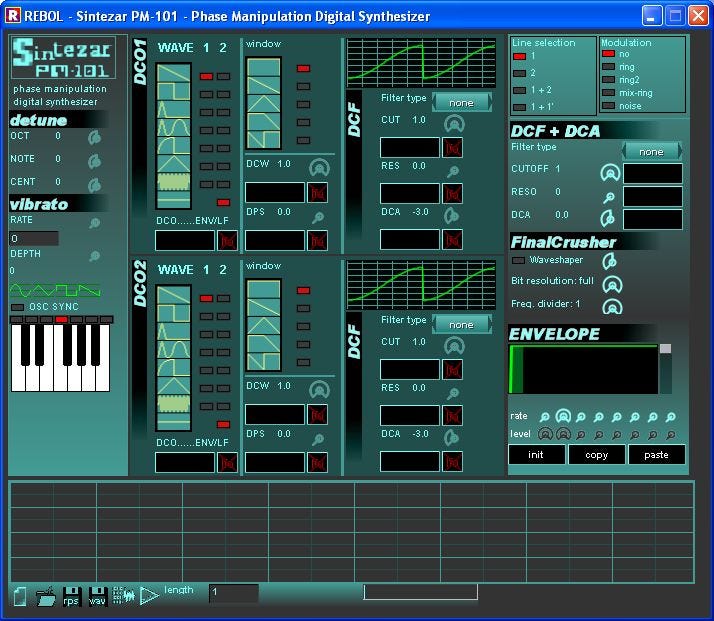
Back before years were counted, I wrote a synthesizer based on the most amazing digital synth of all time, Casio CZ-101. It was slow, it took 10 seconds to render 1 second of sound, but it was highly modulable and had features that CZ-101 can only dream of. I always wanted to make HW version of this toy and I guess that the time has come. With a sweet bonus of a sequencer. What a time! If we can get rid of fascists, of course.
5. So, what’s next?
I’m going to document my progress here. I have a basic sample player ready that was rewritten three or four times and I’ll talk about it in the next post. So, stay tuned and let’s see where does this go! Maybe nowhere, maybe I’ll create something, who knows?